
When you join Scouts, you'll discover some traditions that Scouts have used for more than 100 years. You might have seen older Scouts making a special sign, giving a salute or shaking hands in an unusual way.
But what do they all mean? Let's find out!
1. The Scout Motto: Be Prepared
The Scout Motto is just two words:
BE PREPARED
It doesn't mean carrying everything you own in your rucksack, just in case!
It means being ready to deal with whatever life throws at you.
That might mean:
- Packing your own kit before camp.
- Bringing a waterproof coat when rain is forecast.
- Knowing what to do if someone needs help.
- Being willing to try something new, even when you're nervous.
- Thinking ahead instead of waiting for someone else to sort things out.
Robert Baden-Powell, who started Scouting, wanted young people to be ready in both mind and body.
Being prepared isn't about knowing everything. It's about learning skills, thinking for yourself and being ready to have a go.
Have a think: What's one thing you could do this week to be better prepared?
2. The Scout Sign
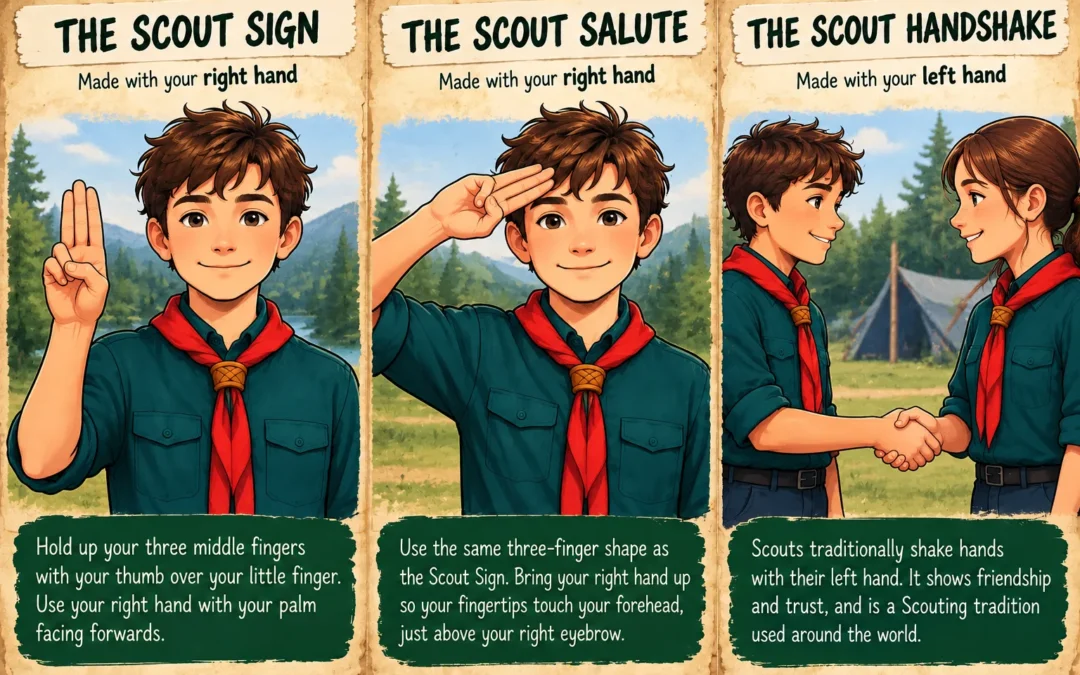
The Scout Sign is made with your right hand.
Raise your right hand to about shoulder height, with your palm facing forwards. Hold up your three middle fingers and use your thumb to hold down your little finger.
The three raised fingers remind us of the three parts of the Scout Promise:
- Our duty to our beliefs and values.
- Our duty to other people.
- Our duty to ourselves.
The thumb resting over the little finger is traditionally said to represent the stronger protecting and helping the weaker.
Scouts use the Scout Sign when making or renewing their Promise.
Give it a try: Can you make the Scout Sign with your right hand?
3. The Scout Salute
The Scout Salute uses the same three-finger shape as the Scout Sign.
This time, bring your right hand up so your fingertips touch your forehead, just above your right eyebrow.
The salute is a way of showing respect and recognising another Scout.
You might use it during a ceremony, when the flag is raised or lowered, or when greeting another Scout in a formal setting.
The important thing isn't making the perfect salute on your first attempt. It's understanding why you're doing it.
Give it a try: What's the difference between the Scout Sign and the Scout Salute?
4. The Scout Handshake
Here's something that might surprise you.
Scouts traditionally shake hands with their left hand, not their right!
The story goes that Baden-Powell learned about the left-handed handshake from people he met in Africa. One traditional explanation is that warriors carried their shields in their left hands, so offering that hand meant putting down their protection and showing trust.
The precise origins of the story are debated, but the meaning has become an important part of Scouting.
The left-handed handshake represents friendship and trust.
When you meet another Scout, perhaps from a different Troop or even another country, you share a tradition that connects Scouts around the world.
Give it a try: Next time you greet one of your leaders, see if you remember which hand Scouts traditionally use!
5. More Than Just Traditions
The Scout Motto, Sign, Salute and Handshake might seem like small things, but they remind us that we're part of something much bigger.
Millions of Scouts around the world share these traditions, even though they might speak different languages or live very different lives.
And remember, being a Scout isn't really about how well you salute or whether you remember the correct handshake.
It's about what you do.
Helping other people, learning new skills, being a good friend and becoming more independent are what Scouting is all about.
So next time you hear someone say Be Prepared, think about what those two words mean to you.
Check Your Knowledge
- What is the Scout Motto, and what does it mean?
- Which hand do you use to make the Scout Sign?
- What do the three raised fingers remind us of?
- How is the Scout Salute different from the Scout Sign?
- Which hand do Scouts traditionally shake with, and what does it represent?
- Can you give an example of being prepared in everyday life?
Your Membership Award
Requirement 2.1: Know the Scout Motto, Sign, Salute and Handshake.
Reading this article will help you understand them, but you'll also need to show a leader that you can demonstrate and explain them.
Why not practise at your next Troop meeting?